


When it comes to selecting optical materials for precision ultraviolet (UV) applications, striking the right balance between high target transmittance and thorough out-of-band blocking is critical. Among the various colored optical glass options available today, ZWB2 (internally recognized as equivalent to Schott UG1 and HOYA U-360) stands out as an industry-standard choice for engineering teams worldwide.
In this comprehensive guide, we will break down the optical characteristics of ZWB2 and explore the top industries leveraging this unique material today.
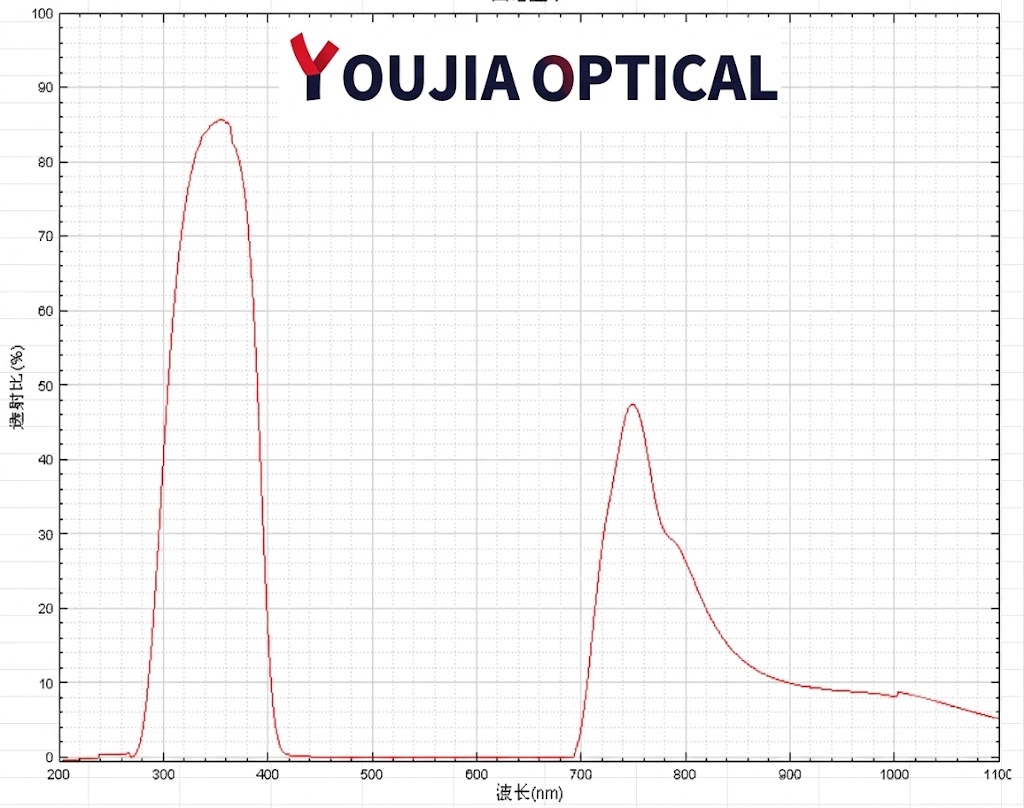
Understanding ZWB2: Optical Performance & Physics
ZWB2 is a specialized ion-colored optical glass designed to function as a selective bandpass filter. Its primary function is to:
- Maximize Transmission: Deliver high transmittance in the long-wave ultraviolet spectrum, with peak performance centered precisely around 365nm.
- Deep Visible Cutoff: Thoroughly absorb and block visible light between 380nm and 700nm, appearing completely black to the naked eye.
By eliminating ambient or background visible light, ZWB2 filters allow sensors and the human eye to detect faint fluorescent reactions with an exceptional contrast ratio.
Top 5 Industrial Applications of ZWB2 Glass
1. Non-Destructive Testing (NDT) & Quality Control
In heavy industries like aerospace, automotive manufacturing, and pressure vessel fabrication, structural integrity is paramount. ZWB2 glass is widely integrated into high-power 365nm UV LED inspection lamps used for:
- Fluorescent Penetrant Inspection (PT)
- Magnetic Particle Inspection (MT)
By blocking any visible “leakage” from the UV light source, ZWB2 ensures that minute, hairline cracks glowing under fluorescent agents are highly visible without background dilution.
2. Precision Optical Instruments & Life Sciences
In laboratory environments, signal-to-noise ratio determines data accuracy. ZWB2 serves as a core optical element in:
- Gel Documentation Systems: Ensuring an ultra-dark background so CMOS sensors can capture weak DNA/RNA band signals excited by UV light.
- Fluorescence Microscopes & Biochem Analyzers: Filtering out redundant excitation wavelengths to focus purely on the target emission spectra.
3. Financial Machinery & High-Security Authentication
Global currencies, passports, and official tax invoices utilize security inks that react to 365nm UV wavelengths. ZWB2 is deployed in high-speed banking equipment, including:
- Banknote Counters & Sorters
- Automatic Vending Validation Modules
- Handheld Border Control Scanners
The glass allows the sensors to capture instantaneous, crisp validation signals without interference from commercial ambient lighting.
4. Industrial UV Curing Systems
Modern manufacturing relies heavily on UV-activated adhesives (such as LOCA structural adhesives, 3D printing resins, and electronic potting compounds) that polymerize at 365nm. ZWB2 acts as a robust protective window for UV curing heads. It permits maximum curing energy to pass through while shielding the delicate internal light source from external debris and minimizing stray wavelengths.
5. Mineralogy, Gemology, and Field Research
Geologists and gemstone appraisers utilize portable UV lamps equipped with ZWB2 filters to identify minerals (such as fluorite and calcite) and grade gemstones. The deep visible cutoff prevents color distortion, allowing professionals to evaluate authentic fluorescent hues in pitch-black visual environments.
Engineering Considerations: Maintenance and Alternatives
While ZWB2 offers outstanding spectral selectivity, optical engineers must account for its physical properties during the system design phase:
- Environmental Sensitivity: As an un-coated, ion-colored substrate, ZWB2 can be prone to mild solarization or surface delamination if exposed to high-humidity environments for extended periods. Proper sealing or desiccant placement in the housing assembly is recommended.
- ZWB1 vs. ZWB2 vs. ZWB3: If your application requires a deeper visible light cutoff at the cost of slight transmittance, ZWB1 is preferred. Conversely, if you require short-wave UV transmission (e.g., 254nm for UVC sterilization monitoring), ZWB3 is the optimal choice.
Custom ZWB2 Optical Solutions from YOUJIA OPTICAL
At YOUJIA OPTICAL, we manufacture and export precision ZWB series filters tailored exactly to your optical setups. Our capabilities include:
- Custom sizing, custom geometry, and ultra-thin dicing.
- Precision double-sided polishing for demanding wavefront requirements.
- Custom AR (Anti-Reflection) coatings optimized for 365nm to drive up transmission limits.
Looking for reliable technical datasheets, CAD drawings, or custom samples for your R&D pipeline?
Contact our technical sales team directly at [email protected] or visit our product category hub to submit an RFQ.